Sunflower hearts vs peanuts: which to buy, and what to put them in
A buying comparison of sunflower hearts and peanuts for UK gardens, using RSPB and BTO guidance, with checked Amazon UK bags and feeders for each and the November–April rule for both.
Affiliate links: Finchwold is an Amazon Associate and earns from qualifying purchases. You do not pay more. How this works.
If you only buy one food this winter, it will probably be one of these two. They are not interchangeable. Each needs its own feeder, they suit slightly different birds, and peanuts carry a quality risk that sunflower hearts do not. The background on both foods is in peanuts and sunflower hearts. This page is the buying comparison, with listings for each.
The sources, opened on 14 November 2026, are the BTO feeding page, the RSPB’s bird feeding page, the RSPB’s bird café page, and the RSPB’s latest feeding guidance dated 30 October 2026. Product details come from Amazon UK listings opened the same day.
We haven't tested this. Figures are as the maker states them (checked 14 November 2026).
Side by side
| Sunflower hearts | Peanuts | |
|---|---|---|
| Feeder | A hanging seed feeder (RSPB café page) | Rigid steel mesh only (RSPB) |
| Birds the RSPB names | Finches, tits and sparrows | Tits and nuthatches |
| Mess | No husks left below the feeder (BTO) | Crumbs inside and under the mesh |
| Quality risk | Goes stale if damp | Aflatoxin; buy aflatoxin-tested from a reputable supplier (RSPB, BTO) |
| Season | November to April | November to April |
The BTO says sunflower hearts cost more than black sunflower seed, but birds feed faster because there is no husk to remove. The RSPB describes hearts as “husk-free and rich in oil and protein” and popular with lots of birds, and says peanuts provide “a valuable source of protein and fat in the colder months”. Neither page ranks one above the other, and nor do we. Many gardens use one feeder of each, a little apart.
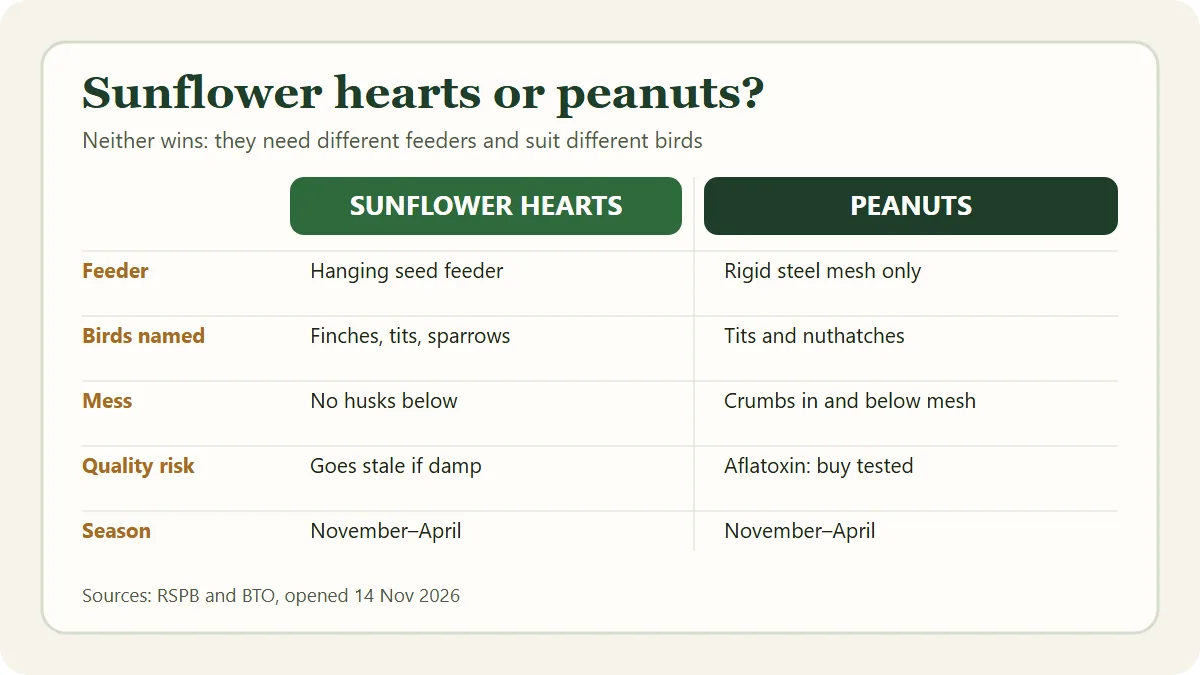
Embed this infographic
<a href="https://finchwold.co.uk/feeding/sunflower-hearts-vs-peanuts/"><img src="https://finchwold.co.uk/assets/images/hearts-vs-peanuts-comparison.webp" alt="Infographic comparing sunflower hearts and peanuts by feeder, named birds, mess, quality risk and the November-to-April feeding season."></a>
<p>Infographic: <a href="https://finchwold.co.uk/feeding/sunflower-hearts-vs-peanuts/">Sunflower hearts vs peanuts: which to buy, and what to put them in</a> from Finchwold.</p>
Peanuts: the feeder is not optional
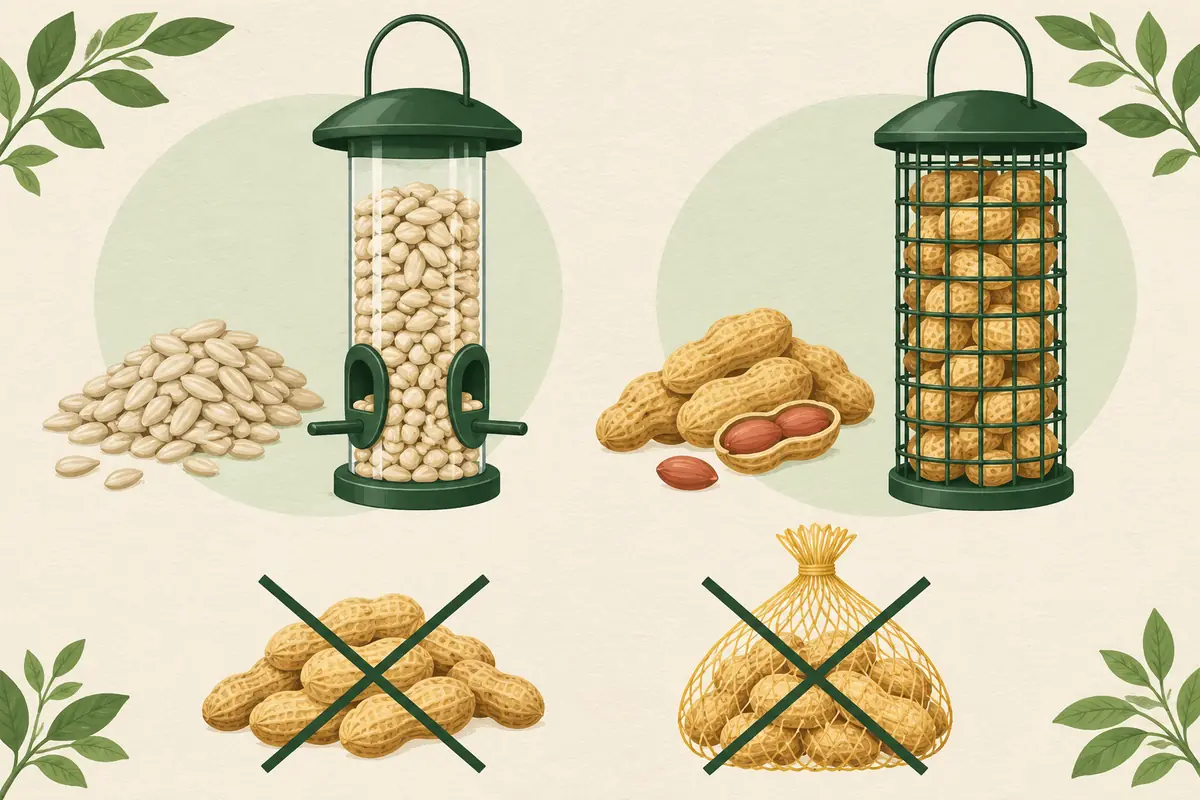
The RSPB says: “Nut feeders made of rigid steel mesh are the only safe method of offering nuts to wild birds.” The BTO says peanuts are best supplied behind a wire mesh “so that a bird cannot take a whole peanut away”. The RSPB café page lists loose peanuts among things to avoid, and says “Never put out any food in mesh bags”, because they can trap birds’ feet and woodpeckers’ beaks. The diagram on this page shows the safe pairings.
On quality, the RSPB says poor-quality peanuts can carry the aflatoxin fungus, “which kills birds if they eat it”, and to buy peanuts “guaranteed aflatoxin-free from a reputable supplier”. The BTO says avoid any that show signs of mould, keep them cool and dry, and buy small quantities.
Hearts: what to buy
Extra Select Sunflower Hearts, 12.75 kg
- Described as bakery-grade kernels from black oil sunflowers, laser-sorted to be husk-free.
- The title says “for year round feeding”. The RSPB and BTO now say to pause seeds from May to October, so treat that as the seller’s wording, not advice.
- Shown as in stock.
Johnston & Jeff Sunflower Hearts for Wild Birds, 12.75 kg
- Described as bakery-grade kernels from black oil sunflower seeds, put through a laser sorting machine to remove husk.
- The listing gives a calorific value of 640 kcal per 100 g and typical protein of 24%, as stated by the seller.
- The listing showed “Only 15 left in stock”.
A 12.75 kg sack is a lot of seed for one feeder. The BTO says buy peanuts in small quantities, and hearts are oily too. Unless you feed several tubes, a big bag needs a sealed, rodent-proof bin; see storing bird food.
Peckish All Weather Sunflower Heart Metal Bird Feeder, Large
- A metal feeder with a quick-release angled base that moves food towards the feeding area.
- Holds approximately 600 g of sunflower seeds; 30 cm tall with the handle extended.
- The listing showed “Only 4 left in stock”.
Peanuts: what to buy
Happy Beaks Peanuts, aflatoxin tested, 12.75 kg
- Described as premium grade and aflatoxin-tested.
- The listing itself says to always use a feeder, to prevent choking hazards.
- Shown as in stock.
RSPB 15 inch Hanging Classic Peanut Feeder
- Listed material: polypropylene and stainless steel. The listed dimensions are 7 × 7 × 25 cm.
- Described as easy to clean and treated against the weather. Sales support the RSPB charity, according to the listing.
- Shown as in stock.
Gardman A01171 Steel Peanut Feeder
- An all-metal peanut feeder with a quick-release top and base for filling and cleaning.
- Holds 240 g of peanuts; 19 cm high, as listed.
- Described as having a “feed safe biocidal coating”. That is the maker’s claim, and weekly cleaning still applies.
- Shown as in stock.
Check the mesh on any peanut feeder before you buy. It should be rigid, not a soft net, and small enough that birds take pieces rather than whole nuts.
Which should you buy?
- For the widest range of seed-eating birds and the least mess, sunflower hearts in a tube.
- For tits and nuthatches, peanuts in rigid steel mesh, bought aflatoxin-tested.
- For a small garden or a balcony, hearts are the tidier choice, because there are no husks and no crumbs.
- For goldfinches, hearts first. The BTO notes a suggestion that some goldfinches now favour hearts over nyjer. If you do add nyjer, see nyjer feeders to buy.
How these compare with suet, mixes and mealworms is in bird foods compared, and the other feeder shapes are in bird feeder types. Both foods draw squirrels and, if spilled, rats; see squirrels, pigeons and rats.
The season and the clean
The RSPB says pause filling feeders with seeds or peanuts from 1 May to 31 October. The BTO says feed seeds and peanuts from November to April. Hearts are a seed, so both foods stop in May. The RSPB says food in feeders should be eaten in one or two days, and feeder hygiene needs doing weekly; see cleaning bird feeders.
Are sunflower hearts better than peanuts?
Neither the RSPB nor the BTO ranks them. Hearts suit a tube feeder and a wide range of birds with less mess; peanuts suit tits and nuthatches and must go behind rigid steel mesh.
Do I need aflatoxin-tested peanuts?
The RSPB says buy peanuts guaranteed aflatoxin-free from a reputable supplier, because poor-quality peanuts can carry the aflatoxin fungus. The BTO says avoid any with signs of mould.
Can I feed either in summer?
The RSPB and BTO both say pause seeds and peanuts from May to October. Sunflower hearts count as seed.