Bird baths for UK gardens: a sourced shortlist
What the RSPB says a good bird bath looks like (wide, shallow, gently sloping, changed daily), the tap-water and rainwater rule, and three listings checked against it.
Affiliate links: Finchwold is an Amazon Associate and earns from qualifying purchases. You do not pay more. How this works.
A bird bath is one of the cheapest things you can add to a garden, and one of the easiest to get wrong. The bath itself matters less than the routine: the RSPB says only offer water if you can change it every day. If you can, a wide, shallow bath is worth having. This page sets out what the RSPB says to look for, then checks three Amazon UK listings against it.
The sources, opened on 14 November 2026, are the RSPB’s make the perfect bird bath page, the RSPB’s bird feeding page, the RSPB’s latest feeding guidance dated 30 October 2026, and the BTO feeding FAQs. Our longer guide to the water itself is water for garden birds.
We haven't tested this. Figures are as the maker states them (checked 14 November 2026).
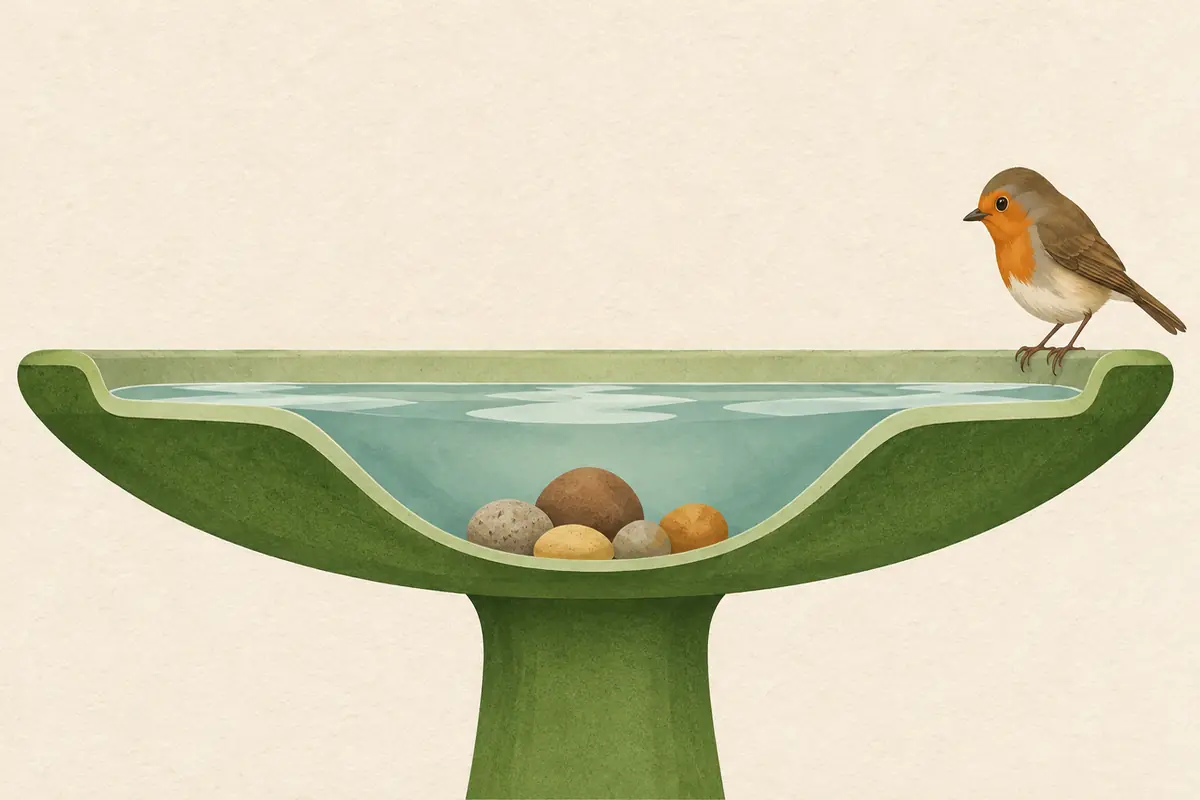
What the RSPB says a good bath looks like
From the RSPB’s bird bath page:
- Shallow. A maximum depth of “only 10cm or so”.
- Wide. As wide as possible, “ideally more than 30cm across”.
- Gently sloping. The ideal bath has “very shallow sloping sides”, so small birds can stand at the edge and larger ones further in. The diagram on this page shows the shape.
- Open, safe ground. An open, flat spot where you can watch, with no long grass or low bush for a cat to hide in and pounce from.
- Anything watertight works. An upturned bin lid, a large plant tray, or an old bowl. You do not have to buy a bath at all.
The RSPB’s own suggestion is a bin lid or a plant saucer. If you buy one, buy it because it is easier to clean, heavier in wind, or nicer to look at, not because birds need a shop-bought bath.
The routine matters more than the bath
The RSPB’s October 2026 guidance says: “Only offer water if you’re able to change it every day”, and “Clean your bird feeders and water baths at least once a week”, using hot soapy water and a non-toxic disinfectant or a mild (5%) bleach solution. The BTO’s FAQs say water sources can be a transmission route for the trichomonas parasite, that water should be replaced daily, and that bowls or trays should be cleaned weekly, then rinsed and dried. The cleaning routine for feeders and baths is in cleaning bird feeders.
If you have a shallow-edged pond nearby, the BTO says there is generally no need for extra water unless the pond has dried out or frozen. See ponds and amphibians.
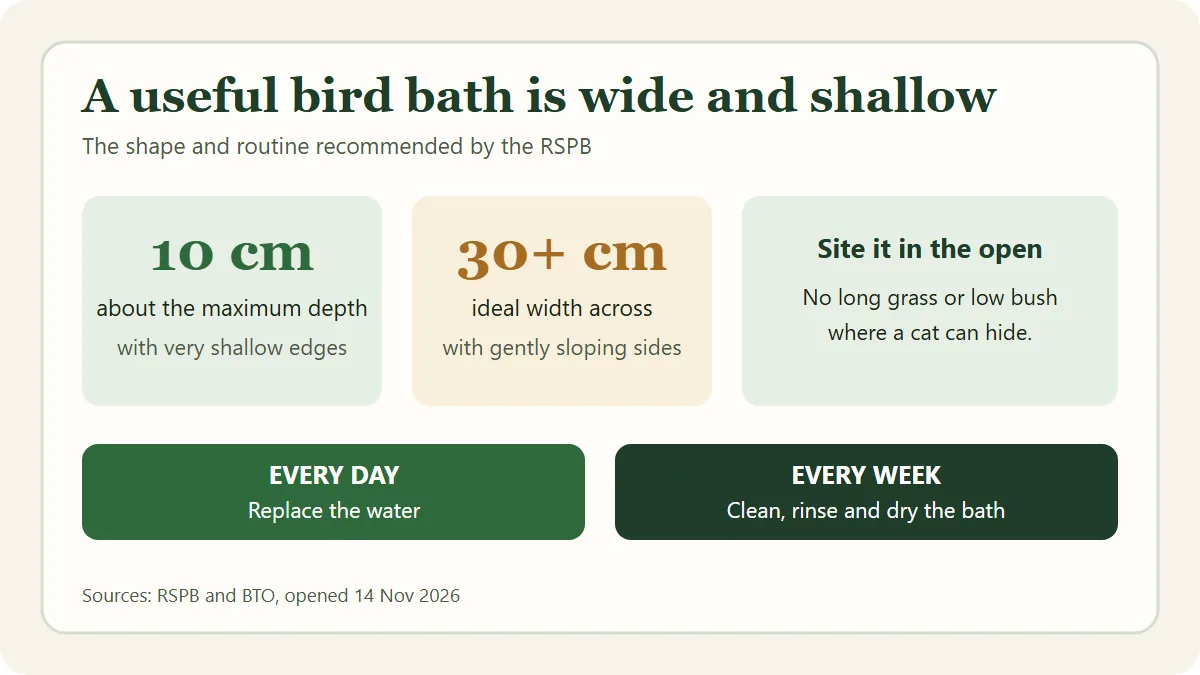
Embed this infographic
<a href="https://finchwold.co.uk/feeding/best-bird-baths-uk/"><img src="https://finchwold.co.uk/assets/images/bird-baths-guidance.webp" alt="Infographic showing a bird bath about 10 cm deep at most, ideally more than 30 cm across with shallow sloping sides, placed in the open, with water changed daily and the bath cleaned weekly."></a>
<p>Infographic: <a href="https://finchwold.co.uk/feeding/best-bird-baths-uk/">Bird baths to buy: three listings checked against RSPB guidance</a> from Finchwold.</p>
Tap water, rainwater and ground level
The RSPB advises tap water, because it is likely to give more protection against disease than rainwater. There is one exception. Its feeding page says: “If you have chloraminated water, only use your tap water in a bird bath that’s off the ground.” For a bath on the ground in that case, it recommends rainwater from a covered water butt, which also stops mosquitoes breeding.
That rule affects what you buy. If your water company uses chloramine and you have no lidded water butt, a raised bath may be simpler than a ground bath. Your water company’s website says how your supply is treated; we have not looked up individual companies.
Three listings, checked against that
Each box below is what the Amazon UK listing stated on 14 November 2026, set against the RSPB’s shape. Prices change, so we do not quote one.
Garden Ornaments & Accessories Round Log Effect With Leaves Ground Bird Bath (40 cm)
- Hand made from concrete, 40 cm in diameter and 6.5 cm high, weighing 8.3 kg, as listed.
- For use on the ground, or as a replacement top for a pedestal.
- Against the RSPB page: wider than 30 cm and shallower than 10 cm. A concrete bowl this heavy will not blow over. The listing does not describe the slope of the sides, so check the photos.
- The listing showed “Only 4 left in stock”.
Garden Ornaments & Accessories 40 cm Round Log Effect Ground Bird Bath
- Hand made from concrete, 40 cm in diameter and 8 cm high, as listed.
- For use on the ground, or as a replacement top.
- Against the RSPB page: wide enough and under 10 cm high overall. It is the deeper of the two log-effect bowls, so a few flat pebbles in the base give small birds a shallow place to stand, as in the RSPB’s example photo.
- The listing showed “Only 4 left in stock”.
Metal Flower Bird Bath, freestanding bowl on a garden stake
- A coated metal bowl that screws onto a two-part cast-iron ground rod, so it stands off the ground. The listed dimensions are 25 × 25 × 5 cm.
- Against the RSPB page: shallow, but narrower than the 30 cm the RSPB suggests, so it suits a small garden or a patio border rather than a crowd of starlings. Being raised, it fits the RSPB’s chloramine rule for tap water.
- The listing describes it as a feeder as well as a bath. Do not put seed in it. A shallow bowl of food is a flat surface, which the RSPB’s current guidance says not to use.
- Shown as in stock.
If none of them suits, a large plant saucer on a level patch of lawn meets every point on the RSPB’s list.
Where to put it
The RSPB wants an open spot with no cover close enough for a cat to ambush birds from. A bath under a bush is the wrong place. A bath a few metres from a hedge, with clear ground around it, gives birds somewhere to retreat without giving a cat a hiding place. More on cats is in cats and garden birds.
Watch the flight line, too. If birds leaving the bath head straight for a large pane of glass, move the bath or put plants in the way; see window strikes.
In winter
A bath that is solid ice is not a water source. The BTO’s exception for ponds, “unless the pond has dried out or frozen”, is when a bath earns its place again. Refill with fresh water rather than adding anything to stop it freezing; the pages we opened recommend no additive. The rest of the cold-weather routine is in feeding garden birds in winter, and the feeders that go with it are in bird feeder types.
How deep should a bird bath be?
The RSPB’s bird bath page says about 10 cm at most, with very shallow sloping sides, and ideally more than 30 cm across.
Should I fill a bird bath with tap water or rainwater?
The RSPB advises tap water. If your supply is chloraminated, it says use tap water only in a bath that is off the ground, and fill a ground-level bath with rainwater from a covered butt.
How often should I clean a bird bath?
Change the water every day and clean and disinfect the bath at least once a week, according to the RSPB’s October 2026 guidance. The BTO says the same: replace water daily, clean weekly.